 RU
 KG
 EN

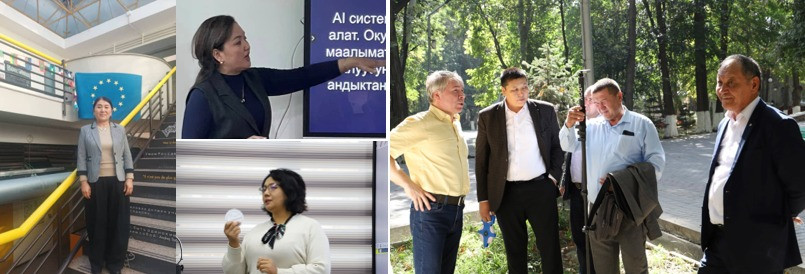
ERASMUS KA171 – University Chieti-Pescara: “Evaluation of the Project – Central Asia – Region 6”
The international project is aimed at improving the quality of higher education in Central Asian countries, developing academic mobility, strengthening inter-university cooperation, and introducing modern educational models in the fields of biology and chemistry.
The project makes a significant contribution to enhancing the university’s integration into the global educational space, developing English-medium professional training, and improving the university’s international ranking and academic standing.
The project is implemented in the following areas:
• organizing academic mobility opportunities for faculty and students;
• introducing innovative teaching methods;
• conducting joint scientific and methodological activities;
• establishing processes for international exchange of experience and other important initiatives.
The project coordinator is G.A. Sagynbayeva, senior lecturer of the Department of Biology, Chemistry, and Environmental Management.
“Education for the Future” Project
Within the framework of the “Education for the Future” project, supported by the Ministry of Education of the Kyrgyz Republic and the World Bank, lecturers of the Department of Informatics and ICT A. Orozbaeva and A. Yrysbayeva served as trainers in the project “Digital Literacy” (“Advantages of Using ICT in the Educational Process”) for school teachers across the republic.
The project is aimed at expanding early childhood education programs, improving the quality of education, and enhancing the digital skills and professional qualifications of preschool educators and school teachers.
The goals and objectives of the project are directly linked to the state education policy and are aligned with the National Development Strategy of the Kyrgyz Republic for 2018–2040.
Project “Assessment of the Ecological State of Tree and Shrub Flora in the Green Zones of Osh City”
This project is funded by the Ministry of Science, Higher Education and Innovations of the Kyrgyz Republic. Project leader: PhD in Biology, Associate Professor R.R. Absatarov.
The research has been conducted since 2024 within the framework of the project aimed at assessing the ecological condition of tree and shrub flora in the green areas of Osh city.
Research methods: analytical and field-experimental methods; standard methods used in forestry, forest selection, and forest inventory; expeditionary and route-based studies, as well as phenological observations.
Research period: 2024–2025–2026.
Main objective: to evaluate the ecological condition of trees and shrubs in the city’s green areas.
Research tasks:
• conducting an inventory of the green zones in Osh city and clarifying their total area;
• studying the species composition of trees and shrubs in various green areas and compiling forest-inventory data (determining age and composition of the stands);
• studying the bioecology of tree and shrub flora, assessing their vital condition and morphometric parameters under urban conditions;
• evaluating the growth and development levels of trees and shrubs;
• identifying and analyzing the spread of pests and diseases, and introducing safe biological control methods;
• determining the level of soil and air pollution in green areas;
• assessing the influence of urban environmental factors—such as noise, emissions, and temperature—on the ecological state of vegetation;
• developing measures and recommendations for improving the ecological condition of tree and shrub vegetation and preparing scientific justification for greening and reconstruction efforts in Osh city.
Objects of study: green zones of Osh city.
Expected outcomes:
- Identification of the biodiversity of tree and shrub species in the city’s green areas;
- Assessment of the ecological condition of the flora, including the degree of damage from pests and diseases;
- Study of environmental pollution levels, including toxic substances such as vehicle emissions;
- Analysis of soil quality, including nutrient content and toxic elements;
- Evaluation of the effectiveness of green-space management, including a set of recommendations for plant care;
- Determination of the influence of climate change and other ecological factors on plant growth and development;
- Study of interactions between trees/shrubs and other organisms such as insects, birds, and animals;
- Assessment of the ecological role of trees and shrubs in the city;
- Development of recommendations for improving the ecological condition of the city’s green areas, including plant care and planting of new seedlings.
The expected results may serve as a basis for developing programs aimed at protecting and improving the ecological condition of green zones, as well as for decision-making regarding plant maintenance and land-use planning.
Practical significance:
The results and the creation of sustainable green zones will contribute to:
• providing suitable opportunities for urban residents to interact with nature;
• preserving and supporting biodiversity in urban environments;
• reducing environmental threats such as air pollution, noise, and the effects of extreme weather events (heatwaves, heavy rains, floods, etc.);
• improving the overall quality of urban life;
• enhancing public health and well-being.