 RU
 KG
 EN

History of the Department of Informatics and New Information Technologies
On the basis of the Faculty of Humanities of Osh Higher College, the department of “Informatics and Computer Engineering” was officially established on February 3, 1999, by Rector’s Order No. 20. The opening of the department marked a new stage in training specialists in information technologies within the educational institution and created broad opportunities for the development of digital education. The first head of the department was appointed Kandalatkhan Turdubaeva Tashpolotovna, who made a significant contribution to the formation of educational and methodological work and the development of the material and technical base.
According to Order No. 100 dated March 18, 1999, the department was transferred under the authority of the Faculty of Management, where its activities continued in a new administrative and organizational direction. From September 24 of the 2003–2004 academic year, the department was headed by Candidate of Historical Sciences, Associate Professor Urmat Tölögönovich Attokurov, who carried out several important initiatives aimed at improving the quality of education, updating laboratory equipment, and enhancing educational programs.
In the 2005–2006 academic year, the department was headed by PhD, Associate Professor M.M. Nazarov, who implemented reforms aimed at the widespread integration of information and communication technologies into the educational process. From April 1, 2006, K.T. Turdubaeva was reappointed as head of the department, contributing significantly to training specialists in line with modern requirements, improving teachers’ qualifications, and advancing work with software tools.
On November 19, 2019, senior lecturer K.T. Berdibekova was appointed Acting Head of the Department. During this period, the department’s activities expanded, and its name was changed to “Informatics and New Information Technologies” in line with modern requirements. Currently, the department trains bachelor's students in Informatics within the Physics-Mathematics Education program and in Applied Mathematics and Informatics, as well as master’s students in Informatics within the Physics-Mathematics Education program.
Today, the Department of Informatics and New Information Technologies employs 11 dedicated instructors. Among them are experienced specialists such as PhD in Pedagogy, Associate Professor Turdubaeva K.T.; PhD in Pedagogy, Associate Professor Arynbaev E.K.; PhD in Pedagogy Orozbaeva A.A.; PhD in Technical Sciences, Associate Professor Kuduev A.Zh.; Senior Lecturer Berdibekova K.T.; Senior Lecturer Jusupbek K.Zh.; and Master’s degree holder Jummabaeva A.N. These experts make significant contributions to the training of qualified professionals and the development of digital education.
There have also been several changes in the department’s leadership.
On November 19, 2024, Candidate of Pedagogical Sciences, Associate Professor Kandakat Tashbolotovna Turdubayeva was elected Acting Head of the Department and continued its activities.
On October 27, 2025, Aynura Abdazovna Orozbayeva was appointed Head of the Department and currently leads the department’s development strategy.
2. The mission, goals, and objectives of the department
• Improve the quality of education by using new teaching technologies and train competitive, highly qualified specialists while developing national advantages.
• Preserve the best traditions of university science, closely collaborate with leading global universities and research institutions, achieve effective results in humanitarian, natural, fundamental and applied sciences, and contribute to the development of society and the country through scientific advancement.
• Educate youth in the spirit of patriotism, humanism, respect for universal human values, and friendship among nations.
• Deliver lectures, practical and laboratory classes in the fields of 550200 “Physics and Mathematics Education” (Informatics profile), 510200 “Applied Mathematics and Informatics,” and the OKBB 230701 “Applied Informatics” program, and train highly qualified bachelors and mid-level specialists.
• Enhance the implementation of new, modern and innovative technologies in the teaching process.
• Develop sectoral computer technologies.
• Train students to apply their knowledge and skills in their professional specialization.
• Ensure strong integration between education and industry, creating opportunities for in-depth study of modern information technologies.
• Conduct lectures, practical and laboratory sessions at a high scientific and methodological level using new teaching technologies.
• Improve the preparation of electronic versions of lectures and practical classes, electronic textbooks and manuals for the department’s disciplines.
• Organize scientific and methodological activities of the department.
• Improve the publication of methodological teaching materials for instructors and students.
• Enhance the professional qualifications of the department’s faculty members.
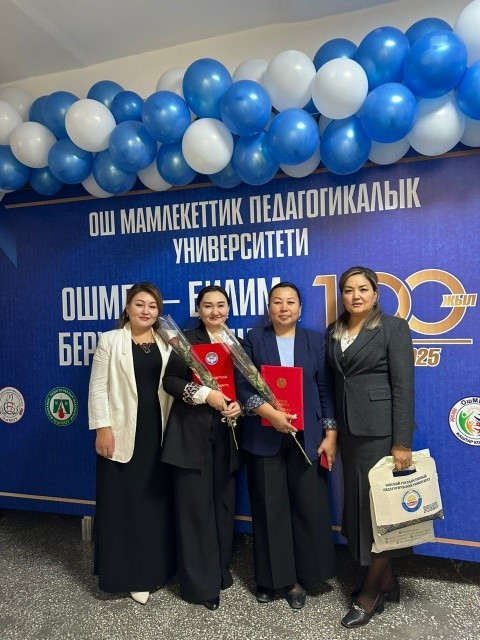
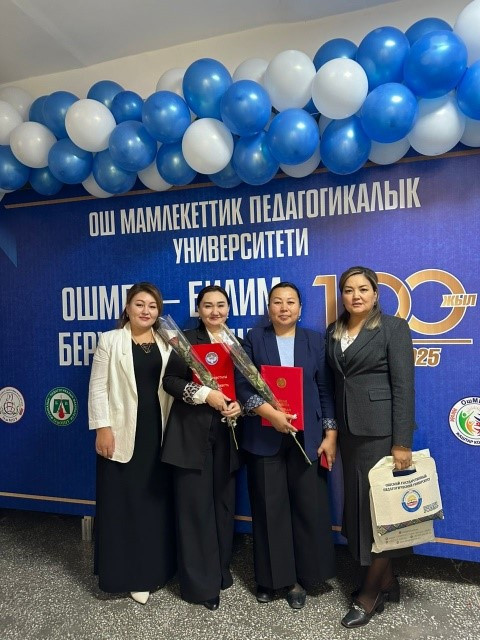
The ceremonial event dedicated to the 100th anniversary of Osh State Pedagogical University continued with an awards presentation. On the occasion of the university’s centenary, the Ministry of Education of the Kyrgyz Republic awarded OshSPU the jubilee medal “100 Years of Kyrgyz Education” for its many years of fruitful work, its contribution to the field of education, and its achievements in teaching and nurturing the younger generation.
Additionally, Eraly Kalilovich Arynbaev, PhD in Pedagogy and Associate Professor of our department, received the honorary badge “Excellence in Science,” while Kandalatkhan Tashpolotovna Turdubaeva, PhD in Pedagogy and Associate Professor, was awarded the badge “Honored Employee of Osh State Pedagogical University” Batma Arymovna Akparalieva was honored with a Certificate of Appreciation from the Plenipotentiary Representative of the President of the Kyrgyz Republic in Osh Region.
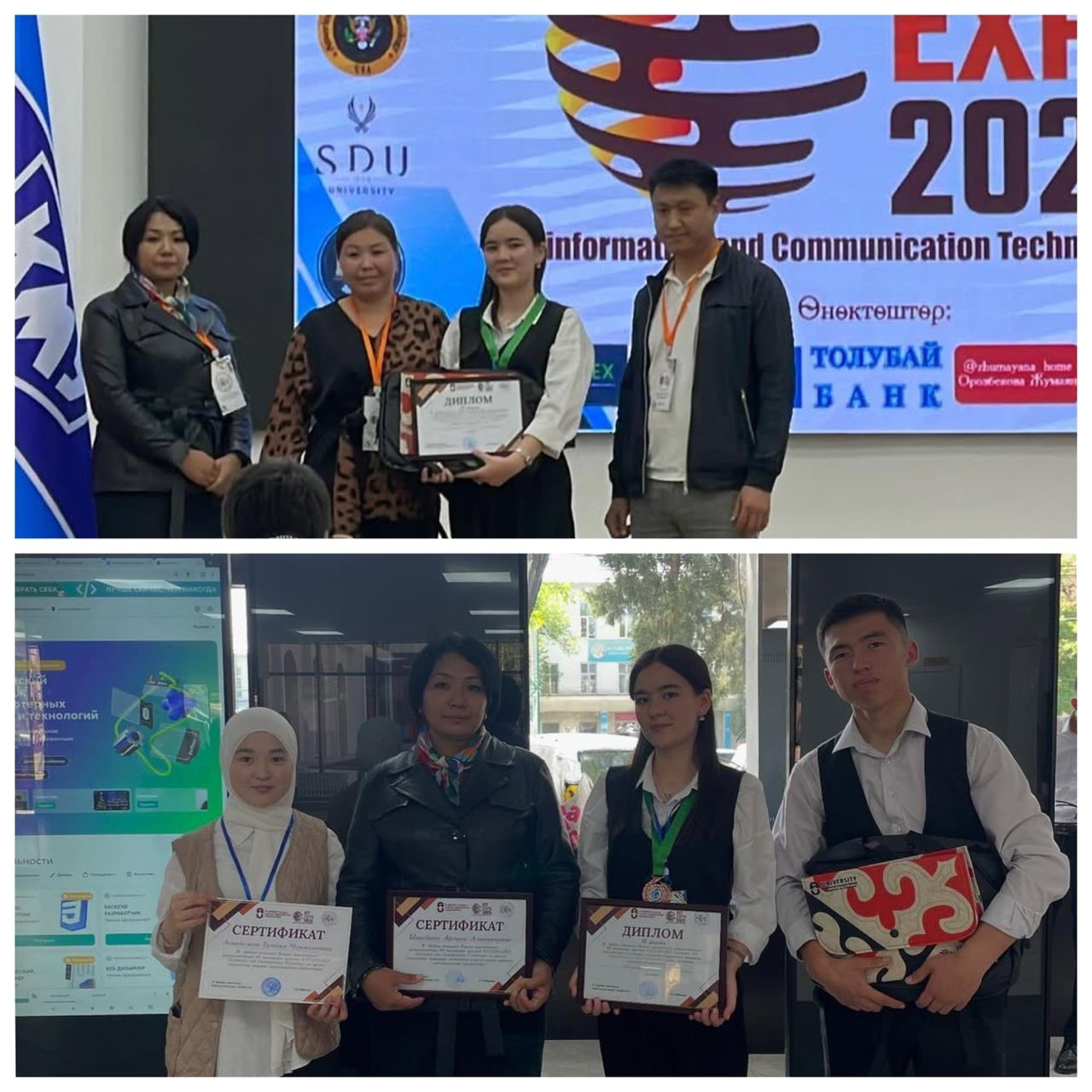
“ICTEXPO-205 Information and Communication Technologies” — International Student Forum (2nd Year)
An International Student Forum within the “ICTEXPO-205 Information and Communication Technologies” program was held at I. Arabaev Kyrgyz State University. The forum was organized in honor of the 80th anniversary of KSU and brought together more than 10 students from various higher education institutions of Kyrgyzstan.
Students of the Informatics specialty of the Faculty of Mathematics and Computer Technologies of Osh State Pedagogical University won 3rd place, and the university received a letter of appreciation, a certificate, and valuable gifts.
The event was conducted in four sections.
The following participants represented the university:
Aizat Askarova — presented her work, research, and developments in robotics and automation;
Orozbek Jakybjanov — presented on the topic of web cameras and websites;
Akayym Akmatalieva — showcased projects in 3D modeling and animation.
The participants gained practical experience and demonstrated their skills and knowledge in their respective fields.
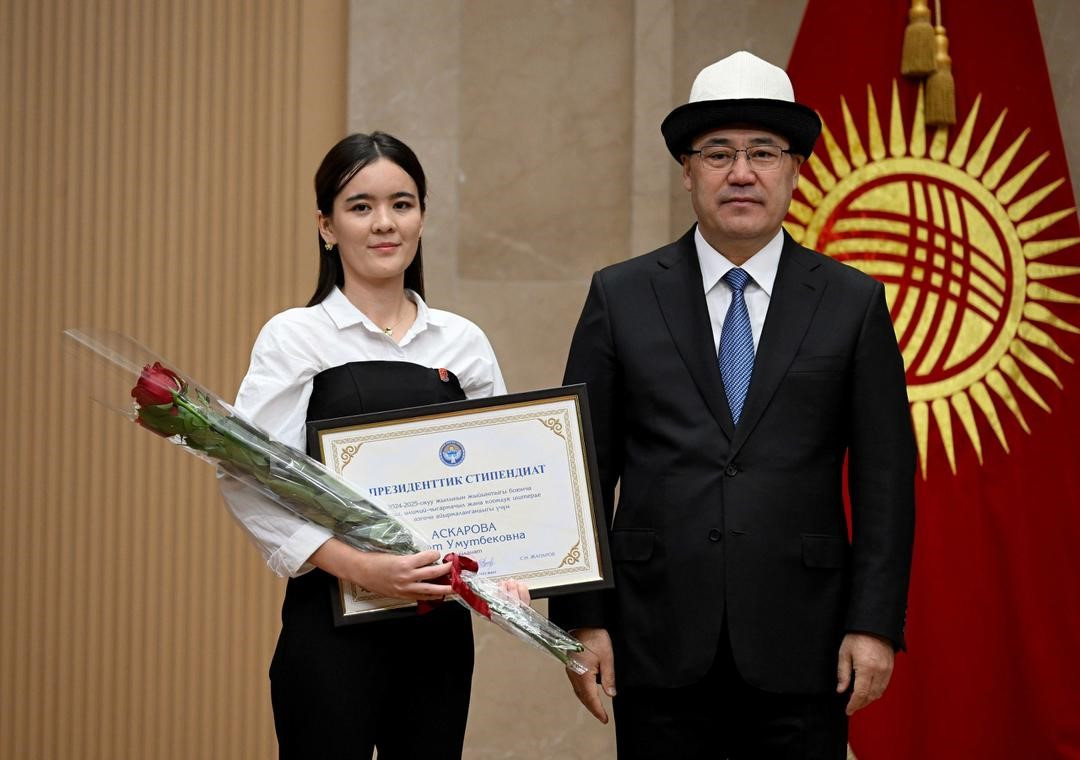
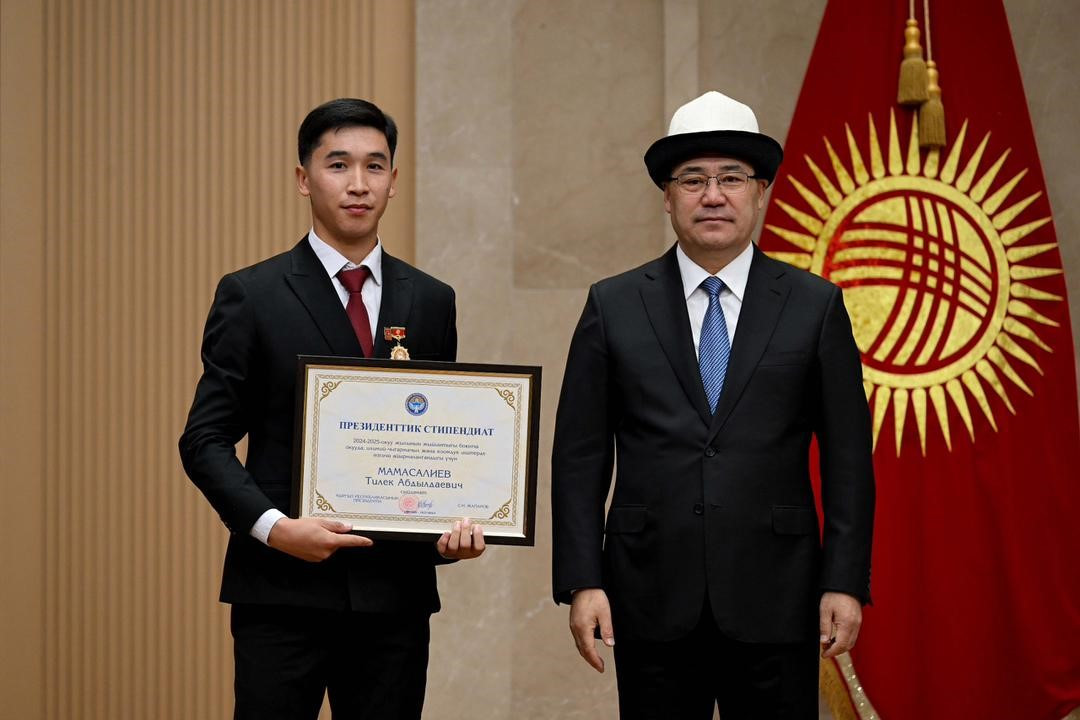
TWO STUDENTS OF THE FACULTY OF MATHEMATICS AND COMPUTER TECHNOLOGIES OF OSH STATE PEDAGOGICAL UNIVERSITY AWARDED THE PRESIDENTIAL SCHOLARSHIP
Today, a ceremony was held to award 92 of the best students from higher educational institutions of the country with the Presidential Scholarship.
President Sadyr Japarov, wishing the students success and new achievements, presented the Presidential Scholarships in the amount of 60,000 soms.
Among the recipients were four outstanding students of Osh State Pedagogical University.
From our Faculty of Mathematics and Computer Technologies, Tilek Mamasaliev and Aizhat Askarova were awarded the prestigious Presidential Scholarship.
“The Presidential Scholarship is not just financial support. It is the result of the tireless work and exceptional talent of students who have made significant contributions to the scientific and social life of universities, and who demonstrate a responsible attitude toward science, creativity, and society,” — said the Head of State.
Work Plan
Work Plan of the Department of Informatics and New Information
Technologies for the 2025–2026 Academic Year
Educational and Organizational Activities
|
№ |
Content of the Work to Be Performed |
Execution Period |
Executors |
|
1 |
Preparation, discussion, and approval of the department council’s work plans |
2025, August |
Head of the Department |
|
2 |
Distribution and approval of teaching loads for the new academic year |
2025, August, September |
Head of the Department |
|
3 |
Inspection of the condition of the department’s classrooms and assignment of responsible instructors |
2025, August |
Head of the Department |
|
4 |
Development of working (syllabus) programs in accordance with standards |
September, October |
Head of the Department |
|
5 |
Approval of educational and methodological activities |
September |
Head of the Department |
|
6 |
Preparation and approval of educational (advisory) work plans |
September |
Advisors |
|
7 |
Distribution of public/departmental responsibilities among faculty members |
September |
Head of the Department |
|
8 |
Preparation of a schedule for mutual class observations among instructors |
September, January |
Laboratory Assistant
|
|
9 |
Proper and high-quality completion of individual teaching plans |
September |
Head of the Department |
|
10 |
Preparation of the schedule of open lessons |
October |
Laboratory Assistant
|
|
11 |
Preparation of the schedule for mutual class observations |
September |
Laboratory Assistant
|
Educational Work
|
|
Content of the Work to Be Performed |
Execution Period |
Executors |
|
1 |
Distribution and redistribution of teaching loads for the 2025–2026 academic year |
July 2026 |
Head of the Department
|
|
2 |
Development of working (syllabus) programs for new courses and revision of existing course programs |
September |
Instructors |
|
3 |
Approval of course project topics and final qualification work topics for full-time and part-time students |
October |
Head of the Department |
|
4 |
Improving the quality of lecture and practical classes, enhancing teaching methods |
Throughout the year |
Head of the Department |
|
5 |
Use of visual aids, technical tools, and best practices in the teaching process |
Throughout the year |
Head of the Department |
|
6 |
Monitoring mutual class observations among instructors, organizing open lessons, discussing results at the department meeting, and determining measures to eliminate deficiencies |
Throughout the year |
Head of the Department |
|
7 |
Defining module questions, preparing tests, improving the formats of their administration, and monitoring deadlines |
September, October |
Deputy Head of the Department and instructors |
|
8 |
Organizing preparation of full-time students for practical and seminar classes and monitoring their independent work |
Throughout the year |
Head of the Department
|
|
9 |
Timely acceptance of course and assessment papers from part-time students, providing methodological guidance |
October |
Deputy Head of the Department and instructors |
|
10 |
Organizing preparation of full-time and part-time students for winter and summer examination sessions |
December |
Deputy Head of the Department |
|
11 |
Developing questions for winter and summer sessions and state attestation, and approving them at the department meeting |
November |
Deputy Head of the Department and instructors |
|
12 |
Organizing and conducting students’ professional internships and summarizing internship results |
November
|
Person responsible for practice, methodologists |
|
13 |
Developing, discussing, and approving module tests |
September |
Instructors |
|
14 |
Analyzing new teaching methods and regularly checking rating evaluation results |
Throughout the year |
Deputy Head of the Department |
|
15 |
Summarizing the results of instructors’ academic and educational work for the first and second semesters and setting objectives for the next period |
December |
Head of the Department |
|
16 |
Organizing and conducting students’ professional internships and summarizing their results |
April 2026 |
Person responsible for practice, methodologists |
|
17 |
Discussing the results of state attestation at the department meeting |
July 2026 |
Head of the Department |
|
18 |
Preparing tests for the Informatics course and developing methodological manuals |
Throughout the year |
Methodologists |
|
19 |
Developing instructional materials for practical and laboratory classes |
Throughout the year |
Instructors |
|
20 |
Development of Electronic Textbooks:
|
Throughout the year |
Instructors |
|
|
Development of an Electronic Learning Resource:
|
Throughout the year |
Instructors |
Educational and methodological work
|
|
Content of the Work to Be Performed |
Execution Period |
Executors |
|
|
Development and discussion of lecture materials for all subjects. |
Each department meeting |
Head of the Department and teachers |
|
|
Review of the NBBP for the programme 550200 “Physics and Mathematics Education” and the profile 510200 “Applied Mathematics and Informatics”. |
September |
Head of the Department and teachers |
|
|
Development and discussion of the methodological design of a practical lesson. |
Each department meeting |
Head of the Department |
|
|
Reviewing and attending open lectures and practical classes conducted by the department’s instructors in their respective subjects. |
Based on the plan
|
Instructors |
|
|
Preparing and discussing MRS questions, as well as midterm and state examination tickets. |
During the semester |
Head of the Department and teachers |
|
|
Developing and approving topics for course papers and assessment works, along with methodological guidelines for their completion. |
October |
Head of the Department and teachers |
|
|
Developing and approving the plan of the department’s educational and methodological activities. |
October |
Head of the Department |
|
|
Preparing tests for each specialized subject. |
November |
Instructors |
|
|
Developing the plan for the Informatics extracurricular club. |
October |
Instructors |
|
|
Preparing comprehensive documentation for part-time students. |
September |
Instructors |
|
|
Hearing reports from the department’s instructors regarding the progress of accreditation preparation. |
October |
Statements from the department members |
Scientific research work
|
|
Content of the Work to Be Performed |
Execution Period |
Executors |
|
1 |
Developing the annual plan for scientific research activities. |
Throughout the year |
Head of the Department |
|
2 |
Participation of the department’s faculty members in regional, national and international scientific conferences. |
Throughout the year |
Head of the Department and instructors
|
|
3 |
Organising and engaging students in academic clubs to deepen their knowledge. |
Throughout the year |
Instructors |
|
4 |
Organising a meeting between students and teachers on the topic “Knowledge makes a person free and elevated.” |
Throughout the year |
Instructors |
|
5 |
Developing topics for students’ scientific reports. |
February
|
All instructors |
|
7 |
Holding a round-table discussion with the participation of experienced university lecturers. |
April
|
Head of the Department |
|
8 |
Summarising the department’s scientific activities for the academic year. |
May |
Head of the Department |
|
10. |
Forming and preparing the Informatics Olympiad team. |
February |
Instructors |
|
11. |
Working with students who are writing their qualification papers. |
During the semester |
Instructors |
|
12. |
Working with master’s students who are writing their dissertations. |
Throughout the year |
Instructors |
|
13. |
Conducting a seminar on the rules for writing essays, course papers and qualification works. |
November March
|
Irysbaeva A.
|
Educational and upbringing activities
|
|
Content of the Work to Be Performed |
Execution Period |
Executors |
|
|
Appointment of a group curator |
September |
Head of the Department |
|
|
Approval of the groups’ educational work plan |
Throughout the year |
Advisors |
|
|
Participation in all cultural and mass events of the Osh MPU faculty |
Throughout the year |
Advisors |
|
|
Organizing clean-up activities to arrange and maintain the assigned classrooms and territories |
Throughout the year |
Advisors |
|
|
Organizing and conducting events dedicated to September 23 — the day the Kyrgyz language was granted official state status |
September |
Head of the Department Curators |
|
|
Conducting joint activities with master’s students (meeting) |
Throughout the year |
Instructors |
|
|
“Have you fully paid the contractual fee?” |
Monthly |
Curators |
|
|
Work with students:
|
September
November
|
Head of the Department Curators |
|
|
Meeting with employers and graduates |
October |
Department members |
|
|
Conducting awareness-raising activities to prevent corruption |
Throughout the year |
Head of the Department Curators |
Educational and methodological activities
|
|
Content of the Work to Be Performed |
Execution Period |
Executors |
|
|
Seminar: “Using the Capabilities of Artificial Intelligence in Education” |
Ежемесячно |
Yrysbayeva A.
|
|
|
Seminar on Media Literacy |
November |
Akparaliyeva B. Dzhumabayeva A. |
|
|
Seminar on the rules for writing essays, term papers, and qualification papers |
November April
|
Jusupbek kyzy Zh Arinbayev K.A.
|
|
|
Seminar: “Information about PISA and development of its sample tasks” |
October |
Turdubaeva K.
|
|
|
Club organization:
|
Throughout the year |
Yrysbayeva A. Turganbayeva A.
|
|
|
Seminar: “Opportunities for Using Online Platforms in the Learning Process” |
Throughout the year |
Kalybekova M.
|
|
|
Club organization:
|
Throughout the year |
Yrysbayeva A. Jusupbek kyzy Zh.
|
Мамлекеттик аккредитацияга даярдык боюнча иш-чаралардын планы(2025-2026)
|
№ |
Content of the Work to Be Performed |
Execution Period |
Executors |
|
|
Conducting an analysis of the quality of the department’s teaching staff by specialty |
Annually |
Department Leadership |
|
|
Reviewing and analyzing instructors’ individual work plans, their implementation quality, and reports |
Annually |
Department |
|
|
Analyzing the library collection and acquiring new books for each specialty |
Annually |
Library, Department |
|
|
Collecting and updating complete student information |
Annually |
|
|
|
Analyzing the number of first-year admitted students and the number of graduates |
Annually |
Department |
|
|
Conducting practice-related conferences with the participation of employers |
Annually |
Methodologists responsible for practice |
|
|
Analyzing the quality of completed term (course) papers |
Annually |
Department |
|
|
Analyzing modular tests for academic subjects |
Annually |
Department |
|
|
Reviewing and discussing the reports of the State Attestation Commission (SAC) |
Annually |
Department Head |
|
|
Checking and updating the approved topics of qualification papers |
Annually |
Commission |
|
|
Conducting expert review of SAC examination tickets for subjects |
Annually |
Department, Exam Commission |
|
|
Collecting feedback from employed graduates by specialty (meetings) |
|
Workgroup |
|
|
Organizing roundtable discussions by specialty |
|
Workgroup |
Meeting Plan of the Department of “Informatics and New Information Technologies” for the 2025–2026 Academic Year
|
№ |
Tasks to be completed |
Deadline |
|
|
1 |
|
September |
|
|
2 |
|
October |
|
|
3 |
|
November |
|
|
4 |
|
December |
|
|
5 |
|
January |
|
|
6 |
|
February |
|
|
7 |
|
March |
|
|
8 |
|
April |
|
|
9 |
|
May |
|
|
10 |
|
June |
|